
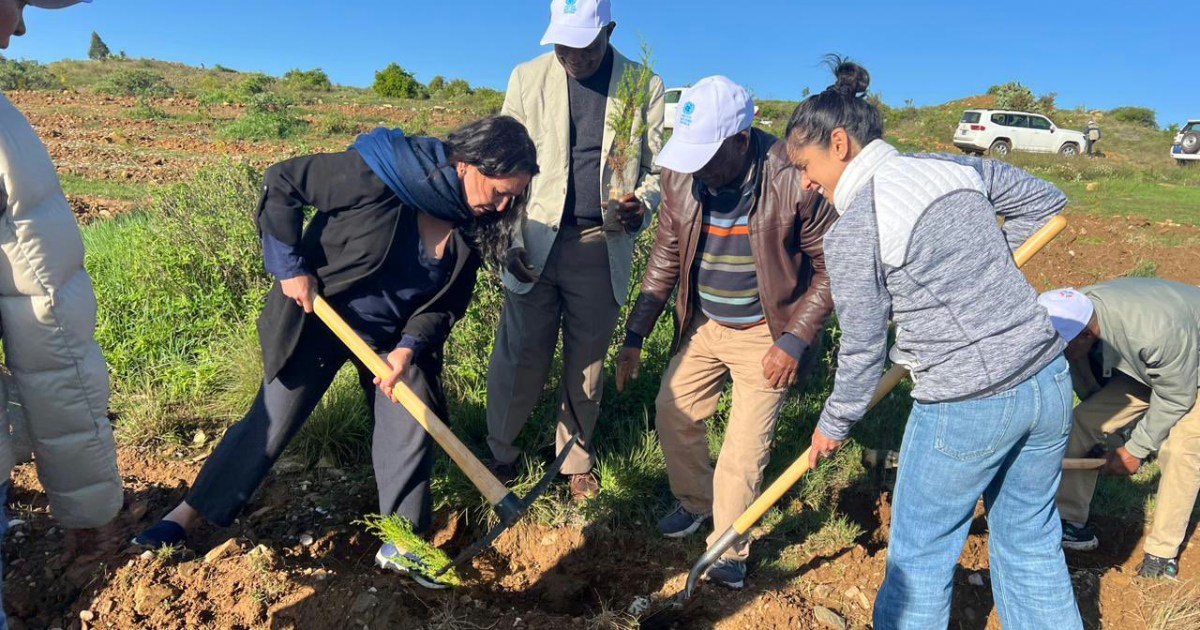
“Impressed by what I saw in Eritrea: rejuvenated forests, increased variety of safe and nutritious foods, renewable energy sources and water projects.” - Reena Ghelani
In the face of increasing climate-related threats, the Government of Eritrea is leading the way with sustainable and integrated approaches to strengthening community resilience and adaptation.
Reena Ghelani, United Nations Assistant Secretary-General, Climate Crisis Coordinator for El Niño/La Niña wrapped up a four-day trip to Eritrea to discuss the Government’s climate priorities, how the UN and partners can accompany the country’s efforts to mitigate the impact of climate change on vulnerable communities, and to learn from Eritrea’s best practices on adaptation, preparedness and response.
Despite contributing only 0.01 per cent to global greenhouse gas emissions, Eritrea is among the most affected by climate change. Average temperatures have already increased by 1.7°C since 1960 and droughts have become more frequent and severe with water insecurity now a significant challenge. Drought in 2021-2023, linked to La Niña and exacerbated by regional instability, led to increased food insecurity and water scarcity, particularly in rural communities.
“By necessity, Eritrea has already made great strides in adapting to the worsening climate realities across the Horn of Africa by applying integrated approaches that build community resilience through climate-smart agriculture, renewable energy and innovative land and water management,” Ms. Ghelani said.
Ms. Ghelani met with a range of Government ministers including the Minister of Land, Water and Environment, Mr. Tesfai Ghebreselasie, the Minister for Agriculture, Mr. Arefaine Berhe and Dr. Giorgis Teklemikael, the Minister of Finance and National Development.
During her mission, Ms. Ghelani visited communities in Areberobue, Maidimnet, Anagule and Mesfuntoto and saw a range of projects that showcase Eritrea’s work on water-resilient infrastructure, irrigation, organic agriculture, green energy and environmental restoration.
“Government’s efforts are commendable,” explained Nahla Valji, the UN Resident Coordinator. “They have a strategic and integrated approach that connects food, water, health, education and community-led development with climate adaptation and preparedness at the centre. This model is leading to progress across a number of Sustainable Development Goals. Enhanced partnerships and access to increased financing will allow Eritrea to take these efforts to scale.”
Eritrea has also expanded its social protection and basic services programs to support those at risk of being left behind by recurring climate shocks.
Source: UNCT Eritrea
Eritrea is on the frontline of climate change, experiencing more frequent and severe droughts.
During my visit to the country last week, I saw great strides towards climate adaptation.
Continued partnership would help the country in its climate efforts.https://t.co/0nrweabyZG pic.twitter.com/0E8EyXjZPs
— Reena Ghelani (@rghelani) August 13, 2024
Impressed by what I saw in Eritrea: rejuvenated forests, increased variety of safe & nutritious foods, renewable energy sources and water projects.
There is a lot to learn from the way Government & partners are investing to protect the environment and build community resilience. pic.twitter.com/5HdRJOJqQk
— Reena Ghelani (@rghelani) August 9, 2024
Great discussions with the Government of Eritrea.
I heard about their integrated programming approach, protecting biodiversity while building community resilience.
I am looking forward to seeing this sustainable approach on the ground. pic.twitter.com/t5vFtzUs4D
— Reena Ghelani (@rghelani) August 9, 2024